
The Maginot Line: France's Impenetrable (and Bypassed) Defense
The Maginot Line was a massive, highly sophisticated line of fortifications built by France in the 1930s to defend its borders against a potential invasion by Germany. Named after the French Minister of War, André Maginot, it remains one of the most famous and infamously bypassed military defense systems in history.
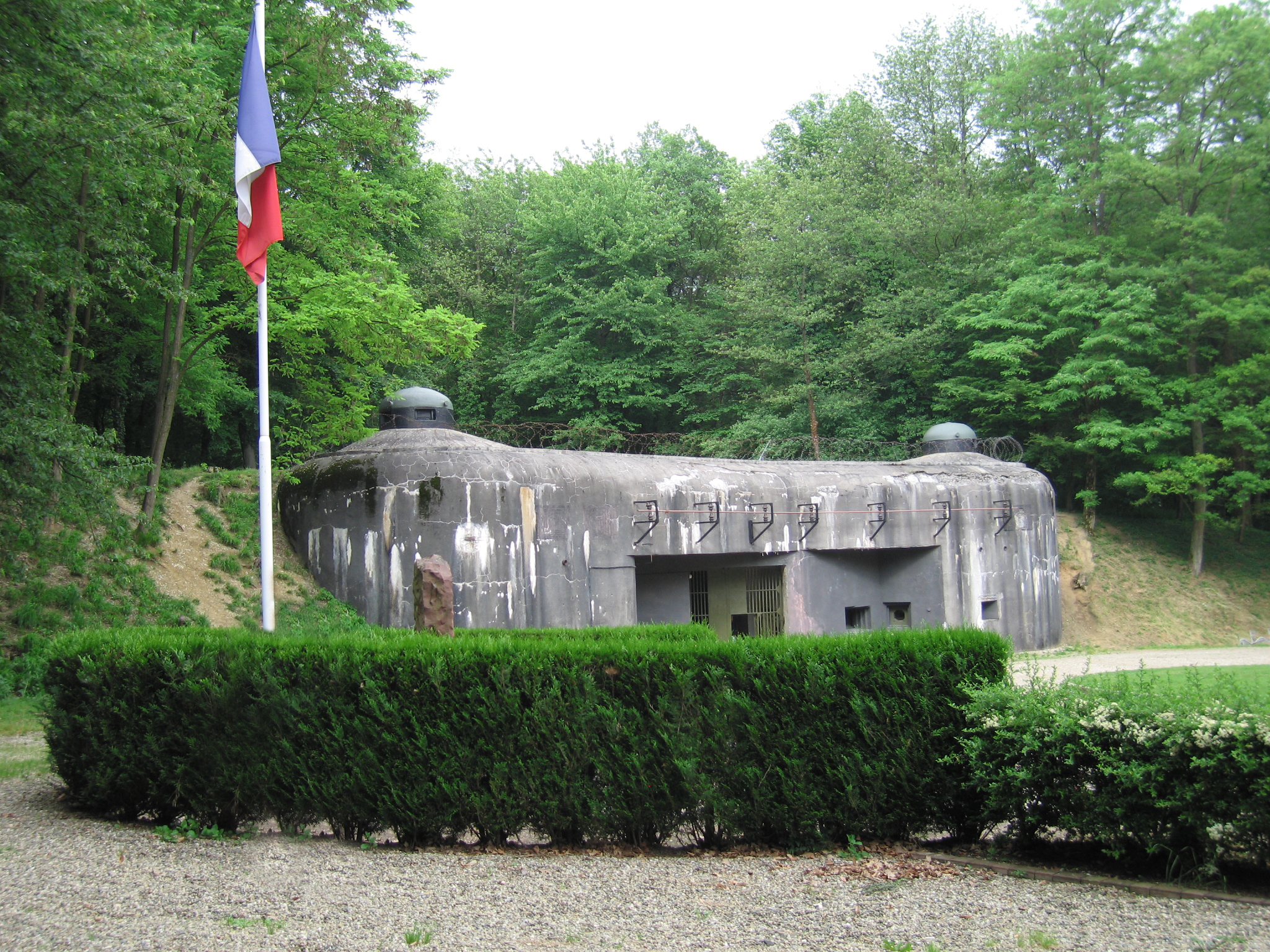
Image source: Wikimedia Commons / Public Domain
Core Design and Features
The line was not just a simple wall or a trench system; it was a state-of-the-art underground fortress network.
- Subterranean Bases: It featured vast underground complexes with living quarters for soldiers, hospitals, ammunition stores, and mess halls.
- Internal Railways: Electric underground trains transported troops and supplies between different forts.
- Heavy Artillery: Retractable gun turrets and heavily armored blockhouses were built to withstand heavy artillery and chemical attacks.
- Air Conditioning and Filtration: The bunkers were pressurized and equipped with air-filtration systems to protect against poison gas.
The Strategic Fatal Flaw
While the Maginot Line was incredibly strong where it was built, it suffered from a massive strategic blind spot.
Ardennes Gap — Left the Ardennes forest undefended, assuming tanks couldn't pass through it. Germans drove straight through.
Belgian Border — The line stopped short of the Belgian border due to cost and politics, leaving a gap Germany exploited entirely.
Static Design — Guns and fortifications couldn't be repositioned or turned around, making the entire line instantly useless once bypassed.
Modern Legacy
Today, the term "Maginot Line" is commonly used as a metaphor for a false sense of security or an expensive, elaborate defensive strategy that relies on outdated assumptions and fails completely against a flexible opponent.
Toccata and Fugue in D Minor
What is a Fugue?
A fugue is a contrapuntal musical form where a short melodic idea, the subject, is introduced by one voice and then imitated by successive voices, each entering while the others continue developing the material. Unlike a melody with simple accompaniment, every voice in a fugue is equally important and carries the same thematic material, just offset in time and sometimes transformed (inverted, reversed, sped up, or slowed down).
Key elements:
- Subject — the main theme, stated alone at the start
- Answer — the subject restated in a different voice, usually at a different pitch
- Countersubject — a secondary theme that accompanies the subject in other voices
- Episodes — transitional passages that develop fragments of the subject and modulate between keys
- Stretto — overlapping entries of the subject, layered closer together, often building intensity near the end
Bach was the master of the form, and Hofstadter uses the fugue throughout Gödel, Escher, Bach as a metaphor for self-reference and recursion: voices that echo and comment on themselves, much like Gödel's self-referential proofs or Escher's impossible loops.
Is AI "Jumping Out of the System"?
Reader Note: While reading this chapter, I asked Claude (Anthropic's AI) whether it could solve the MU puzzle, and then whether doing so counts as "jumping out of the system" the way Hofstadter describes. Claude solved the puzzle instantly using the I-count invariant, but was notably careful not to claim this proved genuine understanding, pointing out it can't be certain whether that reflects real insight or fluent pattern-completion from training data. A fittingly self referential answer, given the book's subject.
Q: Can AI solve the MU puzzle from GEB?
Yes. No sequence of MIU rules can turn "MI" into "MU," because every rule preserves the number of I's modulo 3, and MU has zero I's while MI starts with one that gap can never close.
Q: Does that mean AI is doing the "jump out of the system" move Hofstadter described?
Debatable. Spotting the invariant means reasoning about the rule system from outside it, structurally the same move as Hofstadter's JOOS. But whether that reflects genuine insight, or fluent pattern completion trained on explanations of this exact puzzle, is an open question, one AI itself can't answer with certainty about its own processing.
Q: What did Hofstadter originally mean by this limit?
In 1979, his working model of a computer was a purely mechanical, rule bound process, incapable of stepping outside itself the way Gödel stepped outside arithmetic to prove incompleteness. A human mind could see the pattern; a fixed rule follower, he argued, could not.
Litmus Test?
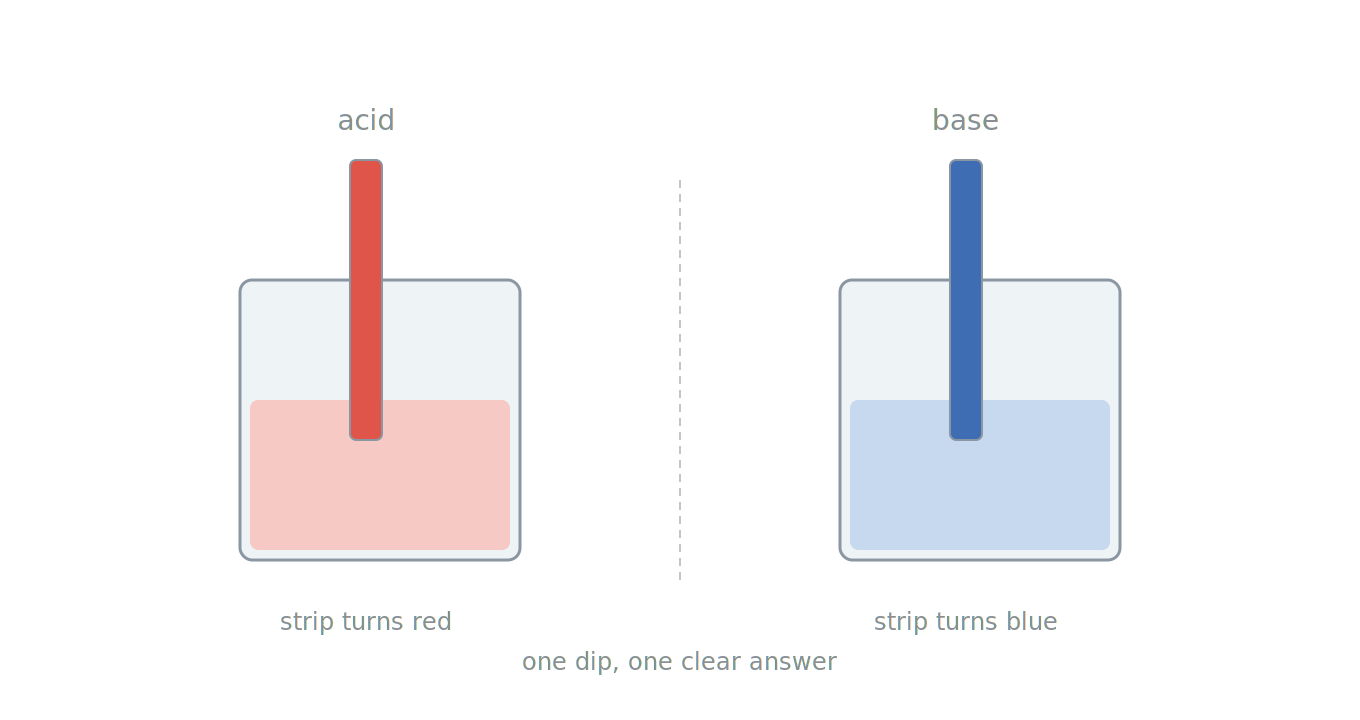
A litmus test is a simple, decisive check that gives a clear yes or no answer, no middle ground. The term comes from actual litmus paper, a strip treated with dye extracted from lichen, used in chemistry to check whether a solution is acidic or basic. Dip it in, and the paper turns red for acid, blue for base. One dip, one answer, no ambiguity.
Outside the lab, the phrase is used the same way: a single question or criterion that quickly reveals which side of a divide something falls on. A litmus test question in politics, for example, is one where a single answer supposedly tells you everything about a candidate's broader position.
The Mandelbrot Set
Benoit Mandelbrot (1924-2010) was a Polish-born French-American mathematician and polymath who spent 35 years at IBM's research center, where access to early computer graphics let him visualize equations no one had ever bothered to draw before. He coined the term "fractal," from the Latin fractus, meaning broken or fractured, to describe shapes with detail at every scale.
He wasn't chasing pure theory; he was interested in the "roughness" of the real world: coastlines, mountains, stock markets, clouds, things classical geometry's smooth circles and lines couldn't capture. In 1980, while exploring a simple iterative equation, he rendered the set that would carry his name and become the most recognizable image in all of mathematics.
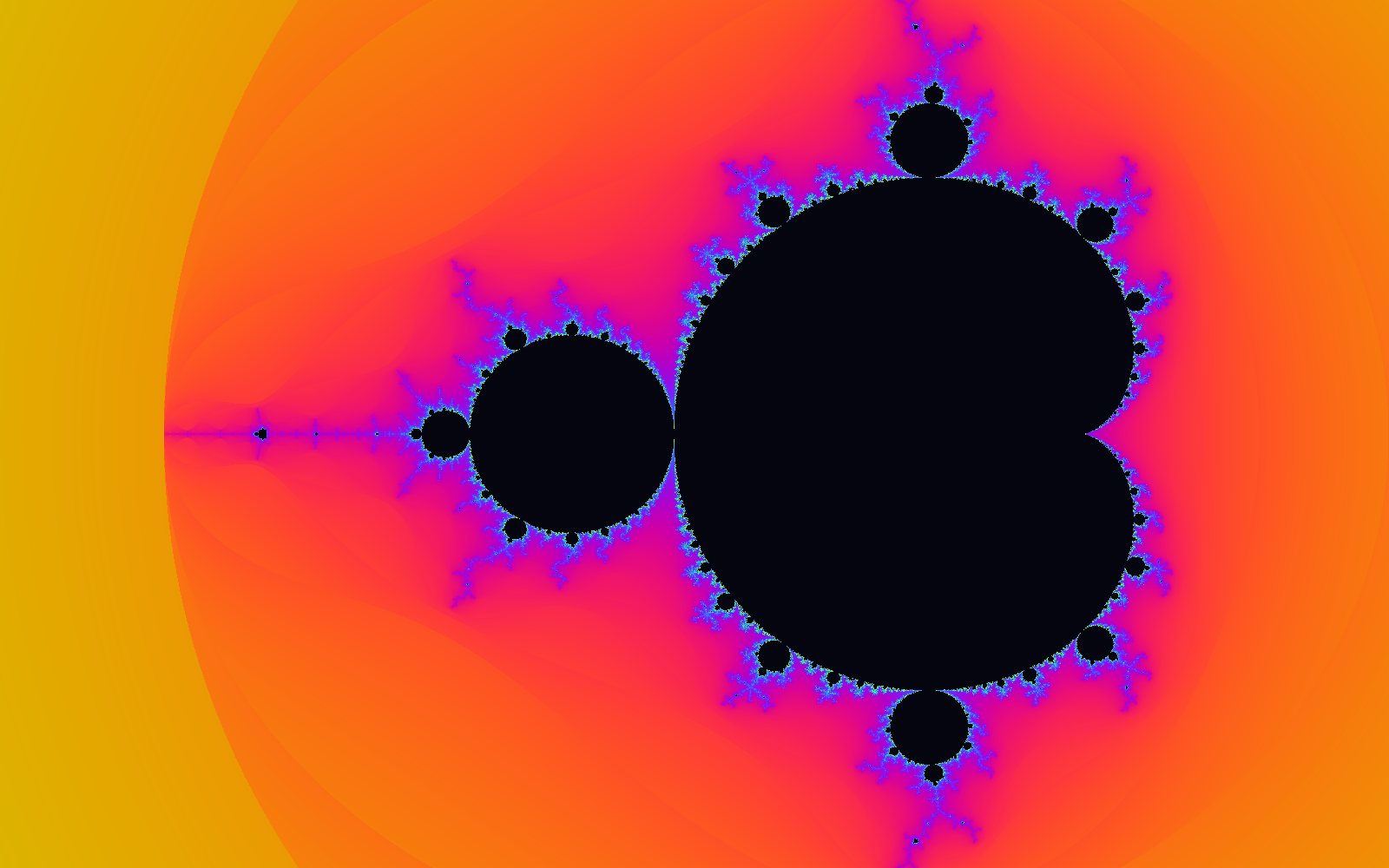
Original artwork by Halit Aydın, generated with Claude. z(n+1) = z(n)² + c, 500 iterations
One Equation, Repeated Forever
The Mandelbrot Set is a shape defined by an almost absurdly simple rule: take a number, square it, add a constant, and repeat. Named after mathematician Benoit Mandelbrot, who popularized it in 1980 while at IBM, it became the iconic image of chaos theory and fractal geometry.
The formula is:
z(n+1) = z(n)^2 + cStart with z = 0. Pick a complex number c. Feed the output back into the equation, over and over. If the result stays bounded (never runs off to infinity), c belongs to the set, colored black. If it escapes, it doesn't, colored by how fast it escaped.